Haruspex
Digital haruspicy: feed it an image and read the prophecy in its corruption.
A haruspex was a Roman priest who read the future in the entrails of sacrificed animals. This one reads images.
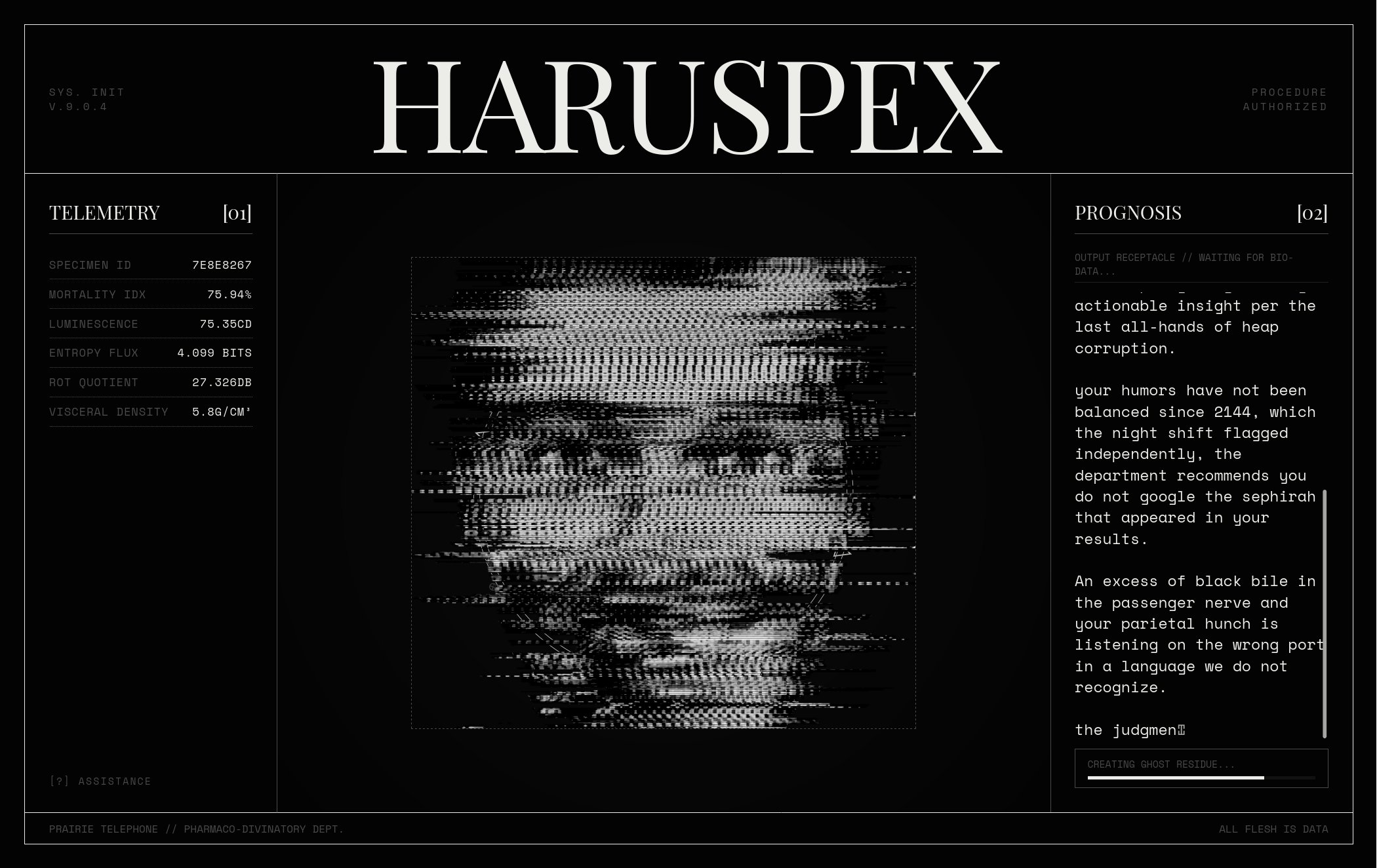
Give it a picture and it performs the reading. The image is examined, then pulled apart, corrupted stage by stage into something glitched and barely legible, while a synthesised score runs underneath and a prophecy is typed out a line at a time. What you get back is an augury: a ruined image, a soundtrack, and a few lines of text, all of it drawn out of the picture you fed in. Nothing is uploaded and nothing is stored; the whole rite happens in the browser, on your machine, and the picture never leaves it.
The reading happens in four movements, and they run together: the image coming apart, the sound shifting under it, the text arriving in fragments between the stages.
The omen
Before anything is destroyed, the image is read. Haruspex scales it down to 100×100 and reduces it to six figures; it calls them mortality, luminescence, rot, visceral, entropy, and an identifier. Those six numbers are the seed of the whole reading; every choice that follows, visual and sonic and textual, is derived from them.
The corruption
The image is broken in nine passes, each a different kind of damage: a threshold crush, an RGB shift, a slice displacement, a channel split, a vertical tear, scanlines, ghosting, block distortion, and a final pass. Each pass is drawn in horizontal strips, so you watch the picture come apart in real time rather than cut to a finished result.
The score
The sound is synthesised live, with no samples and no audio library. A sub-bass sits under three drones, a body resonance, two noise generators (one clean, one bitcrushed), an FM “scrape,” and a thin melodic line off a minor scale. Each of the nine stages has its own voicing, and the live pixel data bends the frequencies and filters frame by frame.
The prophecy
The text is built, not retrieved. A set of templates draws on large hand-written word pools to assemble the augury, divided into nine fragments, one per stage, and typed out character by character with a glyph-scramble effect, the letters settling into place as if a signal were coming into tune.
It is the same every time
It is deterministic. The same image always produces the same reading: the same corruption, the same sounds, the same words. Run it twice and you get the same omen twice.
Two independent pseudo-random streams drive the rite, one for the text and one for the visual damage, and both are seeded from a hash of the image’s own six-figure reading. There is no randomness pulled from the clock or the network. That is the whole idea: the reading is already latent in the picture, and the program only draws it out. Save an omen and it will be there, identical, whenever you come back to it.
Make an offering at haruspex.click.