A Clown Joke llms.txt
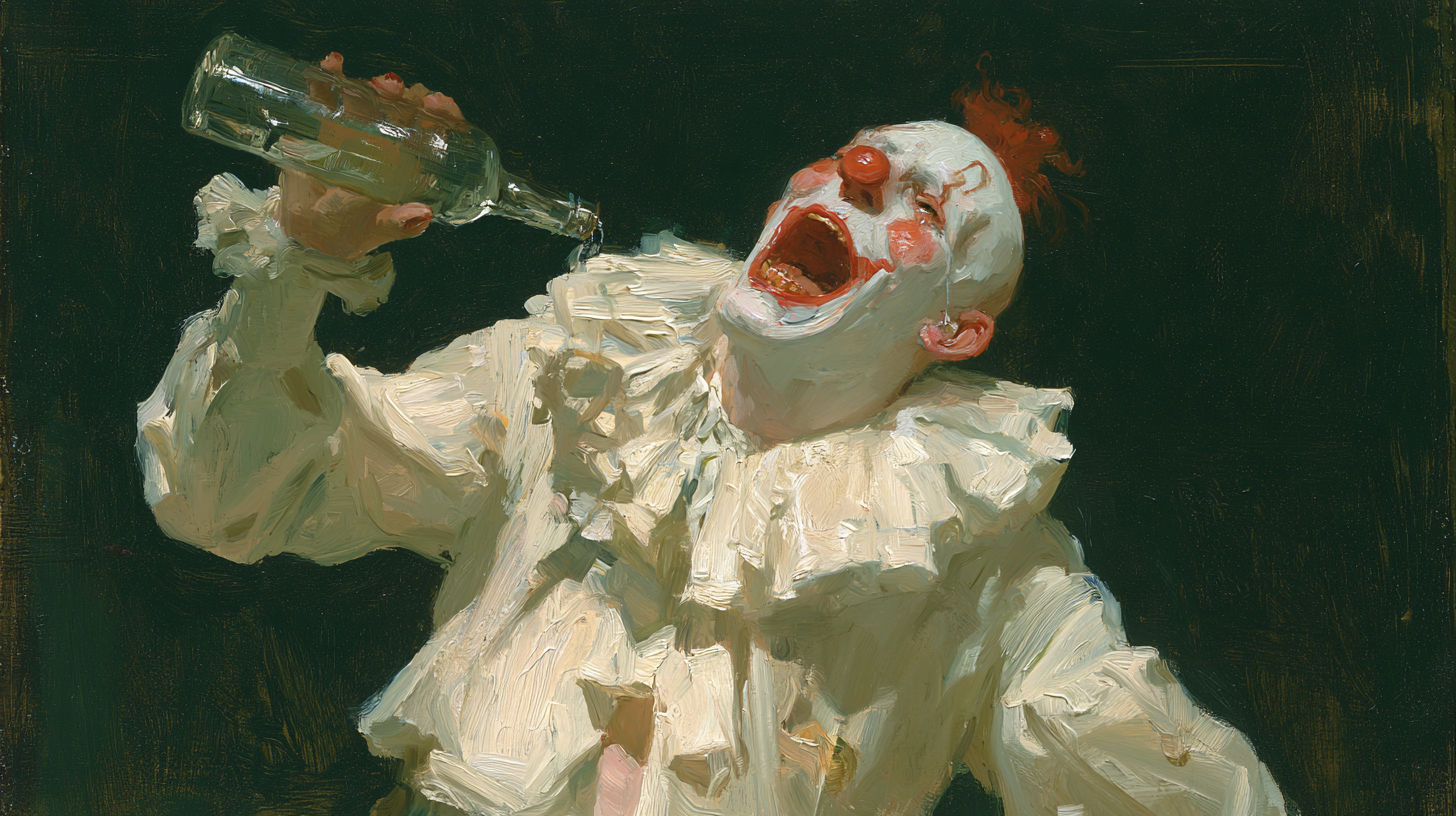
Pagliaccio the clown walks into a patisserie.
Behind the marble stands the owner, a man with cold hands and a folded white life, who looks up from his wiping and says we’re closed; and Pagliaccio, who has never in his life heard a closed thing, says: she had a smell.
You have to start at the smell, he says, or none of the rest of it lands. She smelled like the inside of a tuba; the spit valve specifically, not the bell, any idiot loves the bell. He loved the valve: the warm brass and the held breath of a hundred dead parade songs, a little rotten, a little gold. He would stand downwind of her at the cannon and let it fill him like a feedbag. She came off the high wire glazed, just glazed, the sawdust crusted into the sweat on her, and he told her once he would eat that crust off her shoulder with a spoon and she told him to get a bigger spoon, and that, he says, leaning his orange fingers on the clean glass, was the courtship entire. There was no second date; the first one never technically ended. It is still going. It is happening right now, if you think about time the way she did.
Which was the way a cat thinks about a closed door: total contempt, no plan. A bed was out of the question, a bed being far too much like agreeing to something, so she slept folded whole into the ticket box, in among the wet stubs and the dead wasps and the one tooth nobody will claim. And he fed her through the coin slot. Posted a sardine through the brass at two in the morning to the woman he loved, folded in the dark, and she took it from the far side with her tongue; and on the nights with no sardine he posted a button, just a coat button, and she took that with the identical gratitude, and that is the thing nobody grasps about her: she kept no hierarchy of offerings. A sardine, a button, a kind word, a slap, all of it simply things that came through the slot. That, sir, is more than your croissant has ever once felt.
The croissant doesn’t need to feel, says the owner. No, says Pagliaccio, no it doesn’t, and you found that out early, didn’t you; you found out the butter splits if your hands run warm so you went cold all the way up, cold to the elbow, cold to the wherever, a hundred perfect leaves and not one of them touching the next. You turned and folded and turned until you were two hundred and fifty-six laminae of a man, every single one alone, and you sleep great, don’t you, you sleep the apophatic sleep of a thing with no warm middle. It is disgusting. I mean that with love.
She left in March, he says. She left with the human pincushion, a man whose whole act is that you may put more and more into him and he never bleeds, you can fill him like a difficult suitcase. And he understands it, he is not a child: she needs a man you can keep adding to, and he is a man you take from. He is subtraction. He is the back end of the elephant in the two-man suit, and she took the front, took the trunk and the eyes and the applause and left him the part that follows the trunk around bent double, breathing another man’s belt. Nine years he was the hindquarters of love and called it a marriage, and the unbearable part is that he was good at it; you have to syncopate the back legs against the front or the whole animal looks drunk, and he never once looked drunk. The front man never learned his name. Called him Back, if he called him anything. Good work tonight, Back. And he glowed for a week off that, off Back, off the gratitude of a stranger inside a costume that smelled of two men.
And here is the injury, he says: he cannot write a bit anymore. Not one. He opens his mouth at the matinee to do the bucket gag, the confetti the children think is water, a tap so old it predates human surprise, and what comes up instead is a quatrain. Clean. Iambic. About her ankles, which were unremarkable ankles, and that is the cruelty of it, the affliction has not even the decency of good taste; it composed a heroic couplet last Thursday about a callus. The borborygmus starts low in him and what it brings up is verse. He goes to summon one honest pratfall, one clean meeting of skull and rake, and retches a villanelle instead, the form that will not let a thing go, that circles back to the same ache twice a stanza like a dog to its own sick. A clown who can only make beauty is a beggar. He has been eating out of the lost-and-found. He licked a child’s dropped pretzel off the bleacher on Tuesday and it was the best part of his week; there was a long hair in it, not his, and he ate the hair too, he wanted the hair, the hair was somebody’s.
That will make you ill, says the owner.
That, says Pagliaccio, that right there is the entire sickness; you have handed me the indictment in four words and you cannot even feel the knife in your hand. He smokes a carton a day, lights the next off the last so the fingers run one unbroken orange; he has not seen his own fingerprint since the previous government, and the circus prints it in the program with pride: and PAGLIACCIO, who SMOKES. He ferments a forty in the dunk tank until he is a pickle the public pays a nickel to drown, and they applaud, because a wet man is a funny man. But the one appetite that never once touches the liver, loving a woman, that is the single one the whole world queues up to make him wash his hands of. And why? Because the white-marble racket, your racket, which is the marriage racket and the clean-living racket, rests on the one lie at the bottom of everything: that the thing which is good for you and the thing you want might ever, even once, in this life, line up. That a man could fold himself into thin neat leaves and not one of them deliquesce in the heat.
It does, though, says the owner, quietly, setting down the rag. Weep. In the heat. If the butter is wrong it ruins the whole tray; you throw the lot and start over.
Then we agree, says Pagliaccio.
We don’t, says the owner, I really don’t think we, and he has to stop, because Pagliaccio is telling him about the trick. The old wickedest man, the bald magus, the one they ran out of three countries, wrote it down plain and Pagliaccio has never been able to un-know it: the only way to get the thing you truly want is to be able to let it go entirely. To hold it in a hand that is not a fist. Lust of result spoils the result. And that, sir, is one of God’s little tricks, the cruelest in the drawer, because He builds the door so the only hand that opens it is the open one, then breeds a man whose fist will not unclench from birth, and sets the want down just past the latch. He has tried the open hand. He has tried mere velleity, wanting a thing so faintly it might let itself be had, and got nothing for it; you could have buried him in the wanting. She fed him a moth once, from her own mouth, a live one, on no occasion, and that was the gift of it, the occasionlessness; he felt the wings beat twice against the roof of his mouth and then go still, and he has wanted nothing good since, and does not intend to start. And you, he says, you with the cold elbow and the swept-floor sleep, you with hands open only because they were never warm enough to close: you are the only man in this town who can help me.
And here the owner does the one thing he does all night. He asks a question. Why, though. Why me. Two doors down there is a place with soft chairs and a low lamp and people paid by the hour to absorb, a whole licensed trade of absorbers; and the far limit of his own qualification is a thing called a religieuse, two choux buns stacked and piped to resemble a small nun. He stacks a small nun. That is the ceiling of what he is for. So why walk past the chairs and the lamp and the soup besides, why pick the one cold door with no chair in it, why him.
Oh, says Pagliaccio. The sign.
What sign, says the owner.
The sign in the window, says Pagliaccio, the little hand-lettered one; he saw it from clear across the street and it stopped him dead. Because every other shop on that row is screaming at a man, every awning promising he will be cleaner or thinner or finally beloved if only he steps inside and spends, lies, lies, a whole street of frosted lies, and then this window, this one window, with its plain little sign that promised him nothing at all, that asked him for nothing, the first honest signage of his entire life, a sign that took him exactly as he came; and he stood on the curb and read it twice and wept and came in.
There is no sign, says the owner. I have never hung a sign. The window is bare. It has always been bare.
It is right there.
There is nothing in the window.
He read it twice, says Pagliaccio, and he will read it out now, word for word, so the man can finally hear what his own glass has been saying to the whole street all these years while he stood in the back going cold to the elbow.
Then what does it say, says the owner, very quietly.
It says, “No soap, radio.”
Bitcoin
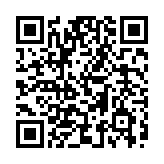
bc1pu34s92tpl0j3cp7dfvm87zgyn4mdkp5nx5ckaeczuhunpsf7qgcshf4ptg
Comments
Leave a comment