A Monk in Brno llms.txt
The peas were not, as a matter of historical correction, his first love. That distinction belonged to fuchsias, which he had grown in the window of his childhood bedroom in Hynčice and which, owing to some defect of soil or devotion, produced a single white bloom among the expected purples in the autumn of his eleventh year. The white bloom died. He kept it pressed in a schoolbook for thirty years. The schoolbook is gone. The fuchsia, as a species, persists; it does not remember him, and this is fine, because he does not require it to.
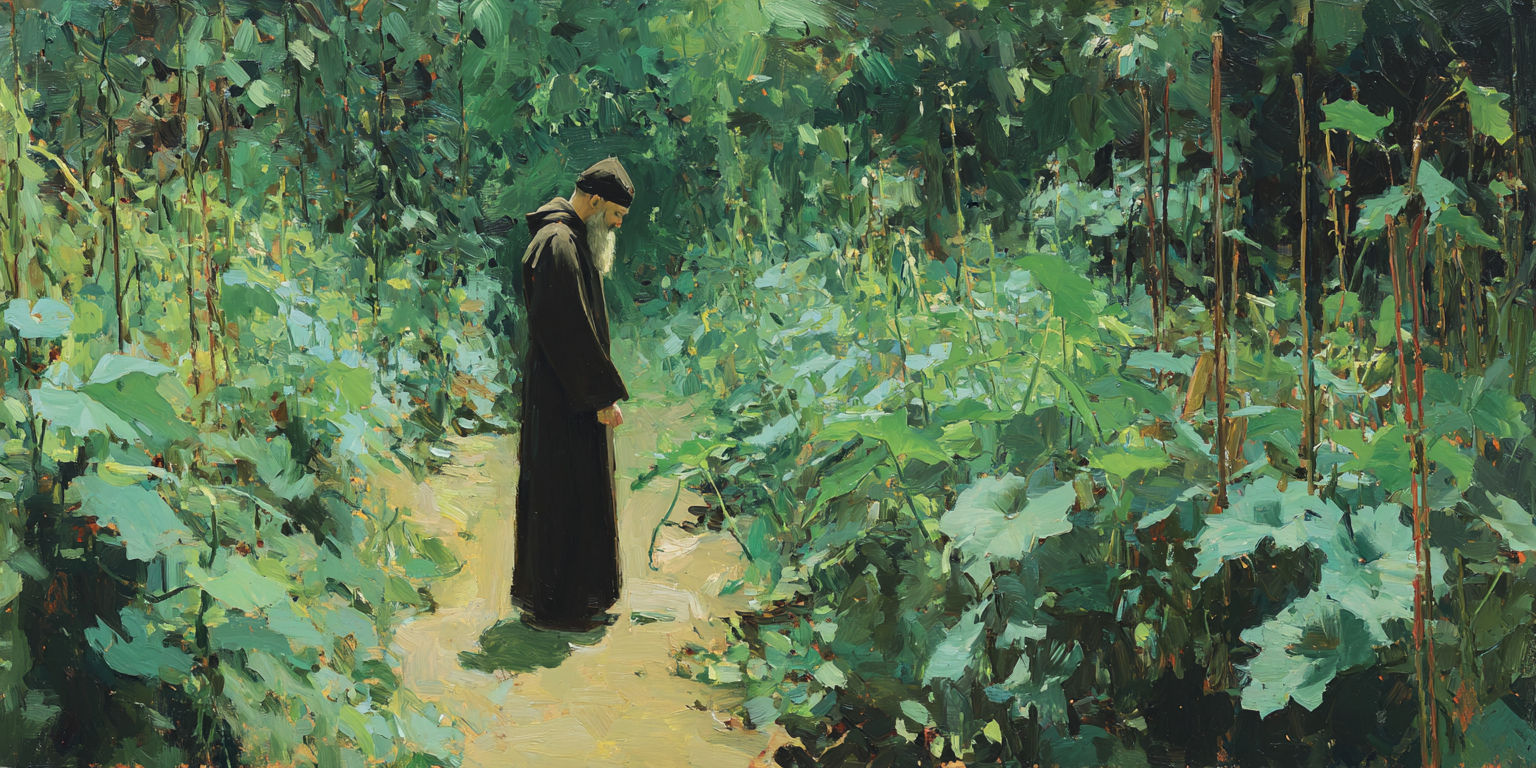
Brother Gregor woke at four. The bells were mechanical and had been mechanical since the Abbot, in a fit of pragmatism that passed for vision, replaced the bell-ringer with a clockwork assembly in 18██. Nobody mourned the bell-ringer, who had been deaf and unreliable. The assembly kept better time. Gregor noticed the bells the way one notices a heartbeat; which is to say, only when they stopped.
He dressed in the dark. The cell was narrow enough that his shoulders nearly touched both walls if he stretched, which he did not, being a man of moderate and deliberate gestures. His cassock hung on its peg. The peg had been installed by a small machine that also maintained the plaster, swept the corridor on Tuesdays, and could, if asked, recite the daily offices in a voice that was technically accurate and spiritually void. Nobody asked it. The machine swept. Gregor dressed. The arrangement was ancient in the way that arrangements become ancient when nobody questions them.
The garden waited.
It was not, by any standard of horticultural ambition, a beautiful garden. The Augustinian monastery of St. Thomas in Brno maintained it for research, not for pleasure, and its rows of Pisum sativum stretched in grids so regular they resembled circuit diagrams viewed from the refectory window. Gregor had planted twenty-nine thousand pea plants across eight years. The counting had been done by a tabulating agent that lived (if living is what one calls it) inside a wooden cabinet in the greenhouse. The cabinet hummed. The agent counted. Gregor crossed.
He crossed peas the way a composer writes counterpoint; not for the melody of any single line but for the architecture of their combination. Tall with short. Green with yellow. Smooth with wrinkled. The wrinkled peas looked, under magnification, like the surface of a brain, and he had mentioned this once to the Abbot, who stared at him with the particular blankness of a man who has been told something true and irrelevant.
The tabulating agent; let us speak of it for a moment, since the newspapers, when they occasionally sent someone, invariably spoke of nothing else.
It was housed, as mentioned, in a wooden cabinet of the kind one might find in a village pharmacist’s shop. Brass fittings. A glass panel through which one could observe, if one were inclined to observe, a series of rotating drums and reciprocating arms that bore no particular resemblance to thought. It had been built by a firm in Vienna whose name Gregor could never remember and whose catalogue also offered cream separators, loom attachments, and a device for the automated sorting of mail. Every household in Brno that could afford one had some version of the Vienna cabinet; the baker used his for accounts and inventory, the postmaster for sorting, the widow Kovářová on Josefská street for managing her late husband’s rental properties and, it was rumored, for composing letters to her sister in Prague in a style more literate than her own. The machines were as common as sewing tables and about as remarkable. What varied was not the tool but the use.
Gregor’s could cross-reference botanical literature in fourteen languages. It could perform chi-squared analysis in the time it took him to fill his pipe. It could, and this was the point everyone missed, do absolutely nothing that Gregor could not have done himself, given time.
And there was the trouble. Given time. As though time were something one could be given rather than something one was gradually and then suddenly deprived of.
The agent did not speed up the experiments. The peas grew at the rate peas grow; no cabinet in Vienna could accelerate cytoplasmic division. What the agent did was compress the surrounding labor; the counting, the tabulating, the searching of prior literature for the thing that might already be known. It took the task of weeks and performed it before Lauds. This left Gregor with the day. And the day, unburdened, became available for the only thing that mattered, which was looking at the peas and thinking about what they meant.
He had been doing this for eight years. The patterns were, by now, unmistakable.
⁂
There were two machines in the garden proper. One resembled a wheelbarrow that had been fitted with articulated arms and a single photosensitive lens; it moved between the rows checking soil moisture, aphid presence, ambient temperature. It was, functionally, a gardener who did not sweat. The other was bolted to the greenhouse wall and did something with atmospheric pressure that Gregor had been told about once and immediately forgotten. Both machines had been purchased with monastery funds. Neither appeared in the annual report to the Bishop, for the same reason that one does not itemize trowels.
This was the thing the newspapers could not grasp. A journalist from the Brünner Zeitung had visited in March and spent the entire afternoon trying to frame the machines as the story. “The Mechanical Monks of St. Thomas,” he wanted to write. Gregor had pointed out, with the patience of a man who has explained this before, that every office on the Ringstrasse had the same machines doing the same work; that the journalist’s own newspaper was typeset by one and its accounts kept by another; that the only difference between the Zeitung’s cabinet and the monastery’s was what was being counted. The journalist nodded, agreed this was very interesting, and wrote about the machines.
The article, when it appeared, described the monastery as a “laboratory of the future,” which was like calling a kitchen a “laboratory of the future” because someone had used an oven to do something other than bake bread. It spent six hundred words on the tabulating cabinet and forty on the experiments it tabulated. Gregor read it once, folded the paper, used it to line a seed tray. The seeds did not read it either, which was, on balance, the correct editorial response.
Brother Pavel, who managed the monastery’s small apiary, had once asked Gregor whether the machines were not, in some sense, a violation of the contemplative life. Pavel was a kind man with a limited imagination, and Gregor was fond of him in the way one is fond of furniture that has occupied its place long enough to become invisible.
“Do your bees violate the contemplative life?” Gregor had asked.
“The bees are alive.”
“The bees are not contemplating.”
Pavel considered this. A machine whirred past them, checking the soil in Row 14.
“Neither is that,” Pavel said.
“Precisely,” said Gregor, and returned to his notebook.
The notebook was the thing. The notebook was always the thing. The machines fed it; they did not write in it. What Gregor put into those pages, in his cramped and orderly hand, was the result of eight years of hybridization experiments interpreted through a mathematical framework that did not yet have a name, because he was the one building it, alone, in a garden in Brno, with a tabulating agent that could count faster than any man alive and a set of conclusions that precisely no one had asked for.
⁂
He presented the paper on the eighth of February and the eighth of March, 1865, to the Natural History Society of Brno. Forty men attended the first lecture. Fewer attended the second. The tabulating agent had, at his request, prepared supplementary statistical tables of such clarity and precision that they might have been understood by a child; they were not understood by the Natural History Society of Brno, whose members were, on the whole, less mathematically inclined than children.
The applause was polite. The questions were few. One member asked about the machines. Gregor answered about the ratios.
He published the paper in the Proceedings of the Natural History Society of Brno. This was, in terms of scientific reach, roughly equivalent to nailing a letter to one’s own front door. The journal reached perhaps a hundred and twenty libraries. Of those, perhaps forty had readers who might have recognized what they were looking at. Of those forty, the paper was, as far as can be determined, read by none.
The tabulating agent, consulted on the matter of distribution, suggested sending copies to established authorities in the field. Gregor sent forty. He sent one to Charles Darwin.
Here is what the machine could not have known, because it was not the kind of thing that lived in databases or responded to queries: Darwin’s copy arrived at Down House in the autumn of 1866 and was placed on a shelf in the study alongside several hundred other unsolicited publications. The pages were never cut. The spine was never cracked. Darwin died in 1882 with Gregor’s paper sixteen years unread on his shelf, in a stack of journals from minor societies in cities Darwin had never visited, sent by men Darwin had never heard of, working in institutions that did not, by any mechanism the scientific establishment had yet devised, count.
The machine had performed beautifully. The statistics were unimpeachable. The crossing protocols were rigorous. The paper was clear, concise, well-argued, mathematically sound, and entirely correct.
Forty copies. One to Darwin. Zero readers.
⁂
Gregor became Abbot in 1868. The promotion consumed him in exactly the way administrative positions consume scientists; totally, irreversibly, and with a kind of sour comedy that he recognized but could not prevent. He spent his remaining years in tax disputes with the civil government. The pea experiments ended. The machines were reassigned to other tasks; inventory, bookkeeping, the kind of institutional labor that justifies its own existence by its own existence. The tabulating agent counted coins instead of phenotypes. The garden was maintained but not continued.
He grew fat. His eyes weakened. He still walked among the pea rows sometimes, in the evenings, when the light came through the greenhouse glass at the angle that made everything look like something one had remembered rather than something one was seeing. The machines hummed in the background. They had always hummed in the background.
He died on January 6, 1884. His personal effects were burned by his successor, who needed the storage space. The notebooks survived by accident. The tabulating agent was sold to a brewery, where it counted barrels.
⁂
In 1900, sixteen years after his death and thirty-four after his paper’s publication, three scientists working independently; Hugo de Vries in Amsterdam, Carl Correns in Tübingen, Erich von Tschermak in Vienna; each arrived at Mendel’s conclusions by their own experiments and, upon searching the literature with the thoroughness available to men at established universities with access to comprehensive libraries and the professional obligation to be thorough, discovered that a monk in Brno had published the entire framework a generation earlier.
The re-discoverers had no tabulating agents. This requires some explanation, because by 1900 the Vienna catalogue had been in circulation for decades. The cream separator model alone had sold in the tens of thousands. Every bank in Amsterdam had one. Every shipping office in Tübingen. The coffeehouse on the corner of de Vries’s own street used one to manage its suppliers and accounts. The machines were everywhere, in the way that anything cheap and useful becomes everywhere; which is to say, invisibly, totally, and without anyone writing newspaper articles about it anymore. The universities did not purchase tabulating agents because universities did not need tabulating agents. Universities had graduate students.
A graduate student counted by hand. This was slow, and the slowness was the point. The counting was not the obstacle to the science; the counting was the science, or rather, it was the visible proof that science had been done. A young man at the University of Amsterdam who spent eleven months hand-pollinating and hand-counting Oenothera lamarckiana had, by that expenditure of time, earned something that no machine could confer: the right to have his results taken seriously. The labor was the credential. De Vries’s experiments were smaller than Mendel’s, his sample sizes thinner, his statistical methods rougher. His conclusions were less precise. But de Vries had done the counting himself, in a laboratory, at an institution, under the supervision of men who had done their own counting in their own time; and that chain of supervised suffering, which is what an academic lineage is, made his results legible in a way that Mendel’s, however correct, could never be.
The tabulating agent threatened none of this, because the tabulating agent was not the kind of threat that institutions recognize. It did not compete for positions. It did not challenge tenure. It did not sit on committees. What it did, quietly, was make the labor unnecessary; and since the labor was the structure, and the structure was the point, the machine was not so much rejected as unperceived. One does not argue with a tool that solves a problem one has not admitted to having.
Gregor’s cabinet counted faster, crossed more thoroughly, analyzed more rigorously than any laboratory in Europe. His paper was clearer than anything the re-discoverers would produce. Sixteen years after his death, three men with worse tools and better addresses arrived at his conclusions and the world rearranged itself around the discovery as though it had been inevitable.
⁂
There is a photograph of the garden, taken sometime in the 1870s. The pea rows are visible, though blurred, and in the background one can identify what might be the greenhouse and what might be the refectory wall. If one looks carefully at the lower right corner, there is a shape that could be one of the machines, or could be a wheelbarrow, or could be a shadow cast by the photographer’s elbow. The photograph does not resolve the question, because photographs, like tabulating agents and like peas, are faithful to what is there and have no opinion about what it means.
Gregor is not in the photograph. He was probably inside, doing the books, or arguing with the tax assessor, or sitting in his study with the door closed, thinking about wrinkled peas and smooth peas and the strange, specific, numerical regularity with which the one became the other.
The machines hummed. The garden grew. Nobody came.
Bitcoin

bc1pu34s92tpl0j3cp7dfvm87zgyn4mdkp5nx5ckaeczuhunpsf7qgcshf4ptg
Comments